Multilingual customer support for DTC brands: a practical guide
Multilingual support means native-level answers in each market's language, not machine-translated replies. For most DTC brands the practical path is a small pool of native-speaking agents covering their top three or four languages, backed by one shared knowledge base (not in-house hires in every country).
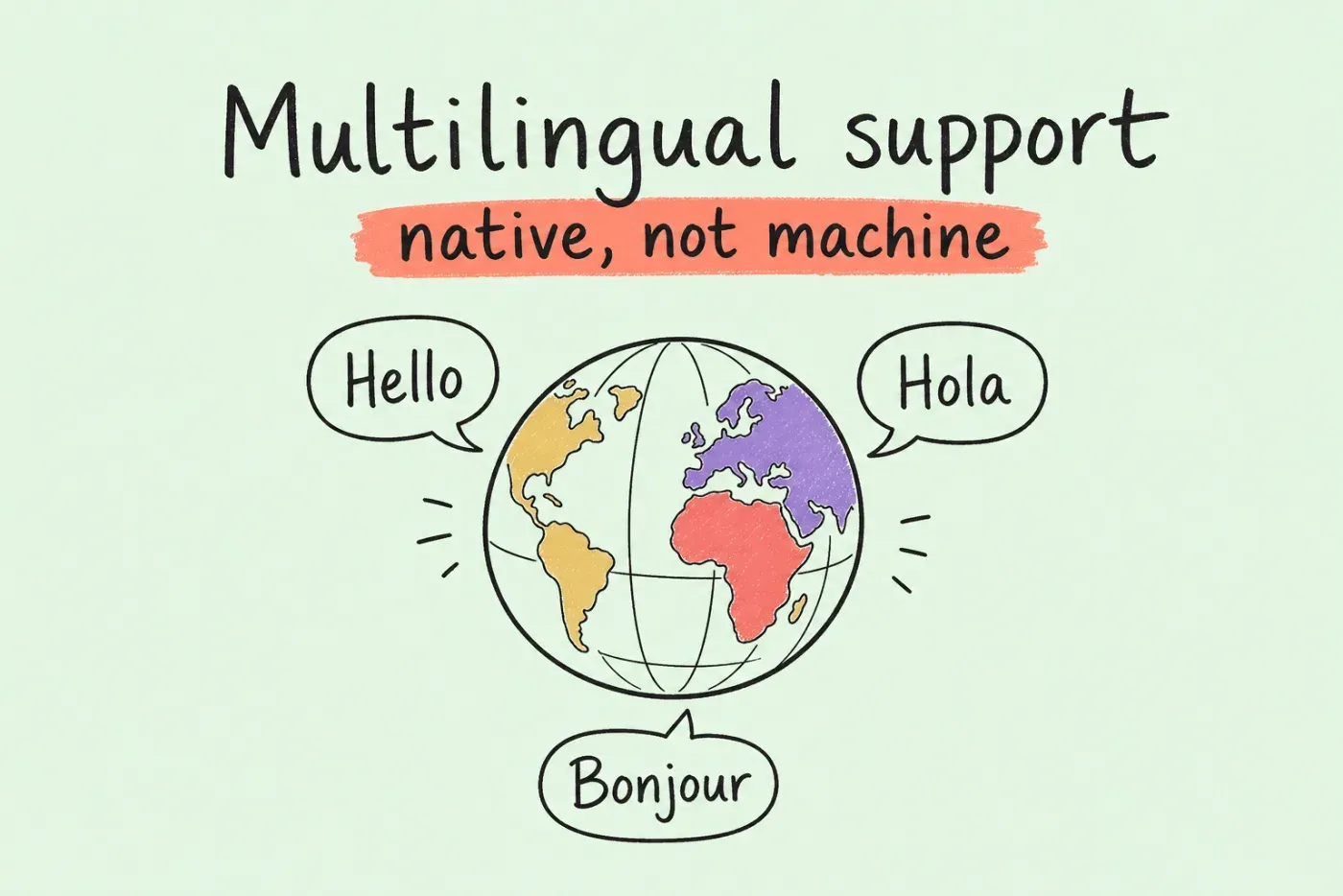
To set up multilingual customer support without hiring in every country, most DTC brands staff a small pool of native-speaking agents who cover the top three or four languages, all working from one shared knowledge base. Rank your markets by real ticket volume, put native speakers on the languages that matter, and localize a single set of policies so every market gets the same answer. That’s the whole model; the rest is execution. And execution matters, because when a customer emails in German and gets a stilted, machine-translated reply, they can tell. For a direct-to-consumer brand selling across borders, language is the difference between a resolved ticket and a refund request.
What does multilingual customer support actually mean?
It means a customer writes in their own language and gets a fluent, culturally appropriate answer from someone who understands the market, not a translated script. Real multilingual support covers three things at once: the language, the local expectations behind it, and the time zone the customer lives in.
Machine translation can help agents draft faster, but it does not replace a native speaker for anything sensitive: a complaint, a warranty dispute, or a refund negotiation. Those are exactly the conversations that decide whether a customer stays.
Which languages should you cover first?
Start from where your revenue already comes from. Pull your order and ticket data by country and rank markets by volume. Most DTC brands find that three or four languages cover the large majority of their non-English tickets: commonly German, French, and Spanish in Europe, plus Arabic for the Middle East.
Cover those well before adding a long tail of languages you can only support occasionally. A market you answer slowly and awkwardly is worse than one you do not claim to serve.
In-house hires or an outsourced team?
Hiring native speakers in every market gives you the most control, but it scales slowly and leaves you paying for full-time coverage in languages that only spike seasonally. For most brands under a few hundred tickets a day, a shared pool of native-speaking agents (covering several languages and time zones from one operation) is more practical and far easier to scale up or down.
The key is that the team works from a single source of truth. When agents in different languages answer from the same knowledge base, your policies stay consistent no matter who replies.
How do you keep answers consistent across languages?
Maintain one knowledge base, then localize it. Product SOPs, refund rules, and macros should live in one place and be translated into each supported language, so a French customer and a German customer get the same policy applied the same way. When your product changes, you update the source once and push the change to every language.
This is where an AI-backed knowledge base earns its keep: it keeps the localized answers in sync and flags when a policy has drifted between languages.
The practical setup
- Rank languages by real ticket volume, not ambition.
- Staff native speakers for your top markets; use machine translation as a drafting aid only.
- Keep one knowledge base and localize it, so policy stays identical across languages.
- Match coverage hours to each market’s daytime, so customers get answers during their day.
Multilingual support is a moat precisely because it is hard to fake. A competitor can copy your product page in a day; a native-speaking team that answers during the customer’s own daytime takes real work to build.