How much does ecommerce customer service outsourcing cost?
Most ecommerce brands pay $8–28 per agent hour for outsourced support: roughly $7–16 in the Philippines, $8–15 in Egypt and North Africa, $12–22 in Eastern Europe, $12–30 in nearshore Latin America, and $28–40+ in the US. A dedicated full-time agent typically runs $1,200–$4,000 per month.
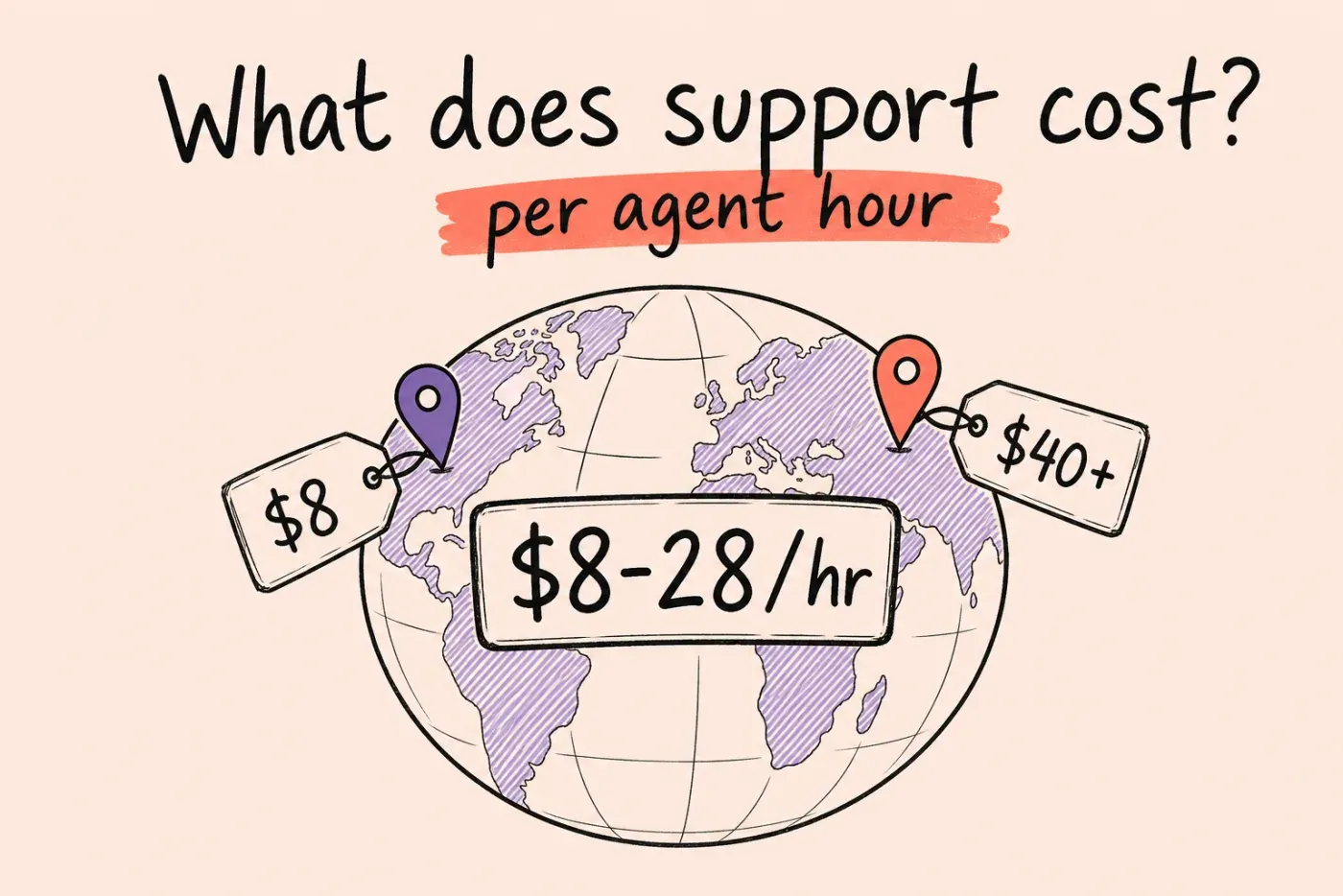
Customer service outsourcing cost is a number every provider quotes differently, yet the pricing guides published across 2025 and 2026 cluster tightly: $8–28 per agent hour for most ecommerce brands. Offshore teams in the Philippines or India typically run $7–16 per hour, Egypt and North Africa $8–15, Eastern Europe $12–22, nearshore Latin America $12–30, and US-based providers $28–40 or more. Billed monthly, a dedicated full-time agent usually costs $1,200–$4,000 depending on where that agent sits. Those are the sticker prices. What a quote will actually cost you takes more digging, which is what the sections below are for.
The four pricing models you will actually see
Almost every quote you receive will use one of these structures, or combine two of them.
Per hour. The most common model. You pay for scheduled agent hours regardless of how many tickets come in. It is simple to budget and works well when volume is steady. The catch: in a slow week you are paying for idle time, and in a spike week you may hit overage rates.
Per ticket or per resolution. Published ranges for ecommerce-type work sit around $0.50–$5 per interaction depending on channel and complexity. This model fits volatile or seasonal volume because you only pay for work done. Read the definitions carefully. A “resolution” that counts a canned macro reply the same as a 40-minute warranty dispute will distort your cost picture fast.
Dedicated agent per month. A flat monthly fee per named agent working only on your account, typically $1,200–$4,500 in published guides, with location driving most of the spread. This is the standard choice once you have enough volume to fill at least one full shift, and it is the model that gives you the most control over training and brand voice.
Hybrid. A base retainer for a core dedicated team, plus per-ticket overflow or performance bonuses on top. Common for ecommerce brands with a pronounced Q4 peak, because it avoids paying peak-season headcount all year.
Customer service outsourcing cost by region
The single biggest price driver is not the provider’s logo or the polish of their sales deck. It is where the agents sit. These are typical published ranges from 2025–2026 provider guides and industry benchmarks, per agent hour:
| Region | Typical published range | Notes |
|---|---|---|
| US / Canada (onshore) | $28–50 | Highest rates; native accent and legal alignment |
| Western Europe | $33–41 | Comparable to onshore US |
| Eastern Europe | $12–22 | Strong European language coverage |
| Latin America (nearshore) | $12–30 | US time zone overlap, bilingual Spanish |
| Philippines / India | $7–16 | Largest talent pools, mature BPO market |
| Egypt / North Africa | $8–15 | English, French, and Arabic; EU-friendly time zone |
Two caveats. First, these are blended market ranges, not quotes: a provider’s actual number depends on scope, channels, and volume. Second, a lower hourly rate does not automatically mean lower total cost. A team that resolves tickets in one touch at $12 per hour is cheaper than one that needs two touches at $9.
Egypt deserves a note because it is still under-discussed relative to its size. Site-selection research puts the country’s call center workforce at roughly 95,000–100,000 professionals, with billable BPO rates in Africa commonly cited at $9–14 per hour. The time zone covers full European business hours and reaches into the US morning and evening, which matters if you sell on both sides of the Atlantic.
Four levers that move the price within a region
Once you have picked a region, four levers explain most of the remaining variance in a quote:
- Channels. Voice costs more than chat, and chat more than email, because phone work cannot be batched and needs tighter staffing. Many quotes price voice 20–50% above ticket channels. Phones are simply expensive. Always have been.
- Coverage hours. Business-hours-only is the baseline. Evenings, weekends, and true 24/7 each add cost because covering one seat around the clock takes several agents, not one (nobody works 168 hours a week, whatever the staffing plan implies).
- Language. Fluent English is the baseline in most offshore markets. Each additional language, especially European ones, narrows the talent pool and raises the rate.
- Volume and complexity. Higher committed volume earns better rates. Technical products, regulated categories, and heavy policy work push rates up; published guides cite premiums of 20–40% for regulated verticals.
The hidden costs most quotes leave out
The hourly rate is rarely the full bill. Before you sign, price these separately:
- Setup and onboarding fees. Published figures range from a few thousand dollars for small programs to six figures for enterprise contracts.
- Training and turnover. Initial agent training is commonly cited at $1,000–$2,000 per agent, and industry annual attrition runs 30–45%, so you will pay to retrain part of the team every year. Ask who absorbs that cost.
- Tooling. Helpdesk seats, telephony minutes, and integrations may or may not be included. A $10 hourly rate plus $150 per agent per month in software is not a $10 rate.
- Quality assurance. Some providers include QA sampling in the base rate; others charge $500–$2,000 per month for dedicated QA coverage. If it is excluded, either you pay extra or nobody is checking the work.
- Your own management time. Weekly syncs, escalation handling, and knowledge base upkeep usually stay on your side. This is the most consistently unbudgeted item in outsourcing plans.
- Minimum commitments. Many providers require 5–10 dedicated agents to start. If you need two, confirm the provider actually serves small teams before spending a week in sales calls.
When outsourcing beats hiring in-house
Published cost comparisons put a fully loaded in-house US support agent at roughly $4,400–$6,700 per month once salary, benefits, software, and management overhead are counted. A dedicated offshore or nearshore agent at $1,200–$3,000 per month does the same seat work for a fraction of that, which is the headline case for outsourcing.
Coverage is the quieter argument, and it usually decides the question earlier.
One in-house hire gives you eight hours a day, five days a week, in one language. The moment you need weekend coverage, a second language, or overnight response for European customers, in-house headcount multiplies faster than volume does. Outsourcing wins early in those scenarios even before the rate difference.
In-house still makes sense when volume is tiny enough for a founder or existing staff to absorb, when the product is so technical that ramp time dominates, or when data policies prohibit third-party access. For most ecommerce brands past roughly one full-time workload of tickets, the math favors an external team.
Comparing quotes without getting fooled
Normalize everything to one number: expected cost per resolved ticket. Take the monthly fee, add every extra you identified above, and divide by realistic resolved volume. A $9 per hour quote and a $14 per hour quote often land closer than they look once QA, tooling, and rework are counted.
Then pilot before you commit. Run one channel or one queue for 60–90 days, track first response time, resolution rate, and CSAT against your current baseline, and only then scale the contract.
Before you talk to a single vendor, pull the last 90 days of ticket data, broken down by channel, hour of day, and language, plus your average handle time. That dataset is what any serious provider needs to quote you accurately, and asking for a quote without it guarantees a padded number. CXharbor’s free CX diagnosis can turn that same dataset into a cost baseline of your current setup before the sales calls start.